
Why Employees Don’t Wear Their ID Badges (and How to Improve Badge Compliance)

Many workplaces require employees to wear ID badges. And in many workplaces, at least a few badges are sitting in a desk drawer, a car cupholder or at the bottom of a tote bag.
It rarely starts as open resistance. No one sends an email announcing they’ve opted out of badge policy. Instead, badges quietly migrate. Into pockets. Onto desks. Into lockers. And eventually, they stay there.
Supervisors issue reminders. Security slows down checkpoints. Replacement badges get ordered. The policy still exists. The system just works a little less smoothly than it should.
The good news is, the issue isn’t attitude. It’s usability.
Employees don’t wake up thinking, “Today I will quietly rebel against badge policy.” More often, something about the badge makes daily wear inconvenient.
If badges are uncomfortable, hard to read or difficult to wear safely, employees will find workarounds. Improving compliance usually means fixing practical design and workflow problems, not tightening enforcement.
Here are the most common reasons employees stop wearing their ID badges — and what organizations can do about it.
Comfort Problems Employees Don’t Always Mention
Badges are worn all day. Small discomforts add up. What feels minor at 8:15 a.m. feels very different at 3:40 p.m.
Common issues include:
- Heavy cards combined with multiple credentials
- Sharp or poorly laminated edges
- Lanyards that rub or pull
- Clips that damage clothing
- Reels that tug or snap back too hard
In an office setting, a standard lanyard may work fine. In healthcare, a retractable reel is often more practical. In manufacturing, a secure clip may be safer and less intrusive.
When attachment types do not match job roles, compliance drops. If an employee removes a badge halfway through a shift because it’s uncomfortable, the issue is design, not discipline.
No one performs better while being slowly poked in the collarbone.
Practical fix: Review attachment types by role instead of issuing the same setup to everyone. Ask employees in each department what works during a full shift. Small ergonomic adjustments often increase daily wear almost immediately.
Readability Problems Make Badges Ineffective
A badge that cannot be read quickly loses importance. If someone has to lean in like they’re trying to read fine print on a warranty, the badge isn’t doing its job.
Common readability problems include:
- Text that’s too small
- Crowded layouts
- Poor color contrast
- Faded print
- Inconsistent layouts across departments
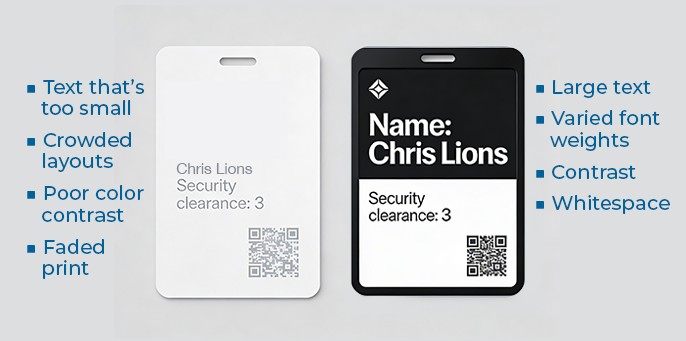
When security or coworkers can’t quickly identify a name or role, the badge starts to feel optional. Over time, employees notice this. If no one can read it without effort, why prioritize wearing it?
Readability isn’t just about font size; it’s about hierarchy. The name should stand out; the photo should be clear; and the background should support the information, not compete with it.
In larger facilities, badges should be readable from several feet away. If they’re not, the visibility requirement becomes theoretical instead of practical.
Practical fix: Test badge readability from six feet away. If names or roles aren’t clearly visible, adjust layout, contrast or font weight. Standardize the design across departments so badges look consistent and intentional.
When badges are easy to read, employees see that they serve a real purpose.
Badge Fatigue and Policy Overload
In some workplaces, employees carry more than one card:
- ID badge
- Access control card
- Parking credential
- Temporary passes
At a certain point, it starts to feel less like identification and more like a key ring collection. If these are separate items with separate attachments, employees juggle multiple pieces throughout the day. Something will eventually land in a pocket and stay there.
Temporary badges can also create confusion. When employees see coworkers wearing temporary versions for extended periods, the policy begins to feel flexible. Inconsistent enforcement reduces perceived importance.
Policy fatigue also appears when different departments apply different standards. If one department strictly enforces visible placement and another does not, employees notice.
They always notice.
Practical fix: Look for consolidation opportunities. Can multiple credentials be combined? Can access control be integrated into the main badge? Simplify wherever possible.
Also review enforcement consistency. The goal isn’t harsher discipline. It’s clear, uniform expectations across roles and locations. When policies are streamlined and consistent, compliance improves naturally.
Visibility and Safety Conflicts
In healthcare, labs and manufacturing environments, visibility requirements sometimes conflict with safety practices.
Common issues include:
- Lanyards catching on equipment
- Badges interfering with personal protective equipment
- Placement rules that don’t align with uniforms
- Infection control concerns
If wearing a badge creates a real or perceived safety risk, employees will remove it. Safety habits are stronger than policy reminders — and they should be.
For example, in a manufacturing setting with moving machinery, a breakaway option or secure clip may be safer than a standard lanyard. In healthcare, badge placement must work with scrubs and protective gowns.
If policy ignores real working conditions, employees will adjust the policy for you.
Practical fix: Work with department leaders to test badge placement in real conditions. Consider breakaway options, shorter lanyards or secure clips depending on the environment. Document approved placement standards by role.
Visibility and safety do not have to compete. With the right attachment and placement guidelines, both can be supported.
Inconsistent Standards Across Locations
For organizations with multiple sites, badge programs often evolve over time: Designs change, vendors change, layouts shift slightly, and attachment types vary. The result is visual inconsistency.
When badges look different from department to department or site to site, they feel less like a unified identification system and more like a patchwork.
Inconsistent standards also make enforcement harder. Supervisors may hesitate to correct placement if there is no clearly documented standard. Those reminders are rarely anyone’s favorite part of the day.
Practical fix: Create a simple badge standard document that defines:
- Layout
- Font hierarchy
- Photo size
- Approved attachment types by role
- Placement expectations
Keep it practical. The goal is operational clarity, not a design manual.
The Hidden Cost of Poor Compliance
Low badge compliance can slow down:
- Security verification at entrances
- Visitor identification
- Emergency response coordination
- Interdepartmental interactions
Supervisors spend time reminding employees. Security teams spend time double-checking identity. Replacement badges are ordered more often when items are misplaced or removed.
Individually, these are small inefficiencies. Across shifts and locations, they add up.
A Simple Way to Evaluate Your Current Badge Program
Before rewriting policies or issuing another reminder email, conduct a short operational review.
Walk your facility and ask:
- Can badges be read clearly from six feet away?
- Are attachment types appropriate for each role?
- Do badges interfere with safety equipment?
- Are layout and placement standards consistent across departments?
- Are employees juggling multiple separate credentials?
You may find that one or two small adjustments make a noticeable difference.

Make Wearing a Badge the Easy Choice
Most employees understand the purpose of ID badges. When compliance drops, it is usually because something about the system makes daily wear inconvenient.
Comfort, readability, safety alignment and consistency all matter. When badges function as practical tools instead of administrative requirements, compliance becomes easier.
Start by asking whether the badge program supports how people actually work. Small design and workflow adjustments often create the biggest improvements. And when wearing a badge becomes the easiest option, compliance usually takes care of itself.
